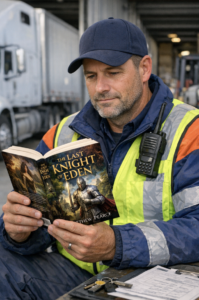
Transportation and logistics work asks a lot from people. It is fast, demanding, unpredictable, and often mentally exhausting. Between shifting schedules, operational pressure, customer demands, disruptions, and constant problem-solving, people in this industry carry a heavy cognitive load every day. That is exactly why The Last Knight of Eden by Matthew Pearce is such a strong fit for transportation and logistics professionals who want fiction that feels immersive, intense, and meaningful after the workday ends.
On Matthew Pearce’s official book page, The Last Knight of Eden is described as a dark modern fantasy centered on Ezra Thorne, a troubled young man pulled into a hidden order, ancient forces, and a dangerous calling tied to the living Word. The story blends secret brotherhoods, mythic conflict, and a modern setting, with themes of pressure, responsibility, and power under strain. It is specifically framed as a dark fantasy for readers who enjoy hidden histories, reluctant heroes, and faith that is not soft or simple.
That combination makes it a smart and satisfying choice for logistics and transportation employees. The genre gives them a break from reality, but the emotional wiring of the story still connects with how they live and work. It is not a lightweight escape. It is a gripping one.
The Transportation and Logistics World Is High-Pressure, and This Book Meets That Energy
People outside the industry often underestimate how mentally demanding transportation and logistics roles are. The work is not only physical or procedural. It is strategic, reactive, and nonstop. Teams are balancing timing, coordination, compliance, communication, and problem-solving at the same time. Even the basic definition of logistics revolves around the organization and movement of goods and resources across complex systems, which is exactly why the field can feel intense day after day.
That kind of environment changes what makes a good book. Logistics employees often do not want something slow, flat, or overly polished after a long day. They want a story with momentum. They want stakes. They want tension that feels alive. The Last Knight of Eden brings that energy immediately through Ezra’s descent into underground tunnels, hidden forces beneath London, and the pressure of being pulled into something far bigger than himself.
The pacing and premise work well for readers who are used to urgency. In logistics, one delayed move can ripple through an entire chain. In dark fantasy, one wrong word, one wrong choice, or one delayed action can do the same. That parallel makes this kind of fiction especially satisfying for people in transportation roles, because the tension feels familiar even while the world is completely different. 🚚🔥
It Offers Escape Without Feeling Empty
A lot of people in transportation and logistics need real mental separation after work. They spend all day in systems, routes, handoffs, schedules, and disruptions. Reading something too close to work can feel like more work. At the same time, reading something too shallow can feel forgettable.
The Last Knight of Eden sits in a strong middle ground. It gives readers a full escape into dark fantasy, secret orders, ancient power, and mythic danger, but it still carries emotional depth and conflict. Ezra is not introduced as a polished hero. He is burdened, uncertain, and dealing with the weight of a broken life before he even faces the supernatural. That makes the story feel human, not just cinematic.
For logistics professionals, that matters. This is a workforce full of people who show up while tired, adapt while stressed, and keep moving while carrying private weight. A character like Ezra feels relatable in the right way. He is not perfect. He is under pressure. He is trying to hold himself together while everything around him gets bigger, darker, and more demanding.
That emotional realism is part of what makes the book feel rewarding instead of just flashy.
The Book’s Themes Mirror What Logistics Workers Live Every Day
Even though The Last Knight of Eden is fantasy, it has themes that line up naturally with transportation and logistics work:
Responsibility. Timing. Trust. Risk. Control. Consequences.
Ezra is pulled into a hidden order where power must be handled carefully, and where people are trying to determine whether he is a miracle or a threat. That kind of tension around judgment and control hits a familiar note for anyone working in logistics operations, dispatch, warehousing, freight coordination, fleet management, or supply chain support. One decision can protect a system or destabilize it.
Logistics professionals also work in environments where unseen systems matter. The public sees a package arrive, a shelf stocked, or a load delivered. They do not always see the chain of people and processes behind it. In The Last Knight of Eden, the public world sits on top of hidden structures too: secret orders, buried dangers, old powers, and forces most people never notice. That “invisible system beneath the surface” feeling is a big reason this book can click so well with logistics readers.
It respects the idea that what keeps the world moving is often hidden.
It Feels Especially Relevant in a Rapidly Changing Industry
Transportation and logistics news has been full of change, uncertainty, and innovation. Industry coverage continues to track freight volatility, logistics technology, automation, capacity shifts, and supply chain strategy at a fast pace. Sources like FreightWaves, Transport Topics, American Journal of Transportation, Supply Chain Dive, DC Velocity, Journal of Commerce, and Logistics Management all reflect how quickly the field moves and how much professionals have to absorb to stay sharp.
That is another reason dark fantasy works so well here. When your job already requires constant adaptation to change, your off-hours reading can become more than entertainment. It can become recovery. A book like The Last Knight of Eden gives the brain a different kind of complexity to engage with. It still feels rich and high-stakes, but it is not asking you to solve tomorrow’s dispatch issue or think through another late shipment.
It gives your mind something epic to hold for a while.
And because the story revolves around hidden forces waking up beneath a modern city, it also scratches that same “what is happening under the surface” instinct that logistics workers use professionally. In operations, the visible problem is rarely the whole problem. In this book, the visible world is not the whole world either. That thematic overlap makes the reading experience feel surprisingly natural.
Dark Fantasy Is a Strong Fit for People Who Handle Real-World Chaos
Transportation and logistics employees are often calm under pressure because they have to be. They are used to disruptions. They are used to imperfect information. They are used to moving forward while conditions are still changing.
Dark fantasy is built for that mindset.
The Last Knight of Eden is not a soft fantasy built around simple comfort. It is darker, heavier, and more charged. There are ancient threats, moral tension, and a sense that power can heal or destroy depending on how it is handled. Ezra is learning in real time, and the people around him are not all united in what they think he should become.
That kind of story structure appeals to people who understand complexity. Logistics workers deal with competing priorities all the time: speed versus cost, service versus capacity, risk versus opportunity, short-term fixes versus long-term stability. A dark fantasy with layered motives and uncertain outcomes feels more satisfying than a clean, predictable story because it reflects how real life actually feels.
It also delivers something many hard-working professionals need but do not always make space for: awe. 🌒📚
Awe matters. It resets perspective. It gives the mind room to breathe. And when it is tied to a story with danger, mystery, and meaning, it can be deeply energizing.
It Is a Smart Pick for Team Culture, Too
In a lot of transportation and logistics workplaces, reading recommendations tend to stay practical: leadership books, operations books, productivity books, business books. Those have value, but fiction can bring a different kind of benefit to a team culture.
A strong novel gives people something enjoyable to share that is not tied to metrics, deadlines, or performance. It creates conversation around character, choices, symbolism, and plot instead of only rates, lanes, claims, and schedules. That kind of balance can be healthy in high-output environments.
The Last Knight of Eden is especially good for that because it is dramatic and cinematic enough to be memorable, but thoughtful enough to discuss. The hidden-order concept, Ezra’s role, the moral tension around power, and the darker spiritual undertones all give people real material to talk about after they finish. It is the kind of story that can actually stick with someone.
It also helps that the book is modern in feel while still rooted in mythic ideas. That makes it more accessible for readers who may not usually pick up fantasy. They get the energy of a contemporary story with the depth and atmosphere of something older and larger.
It Connects with the Human Side of Work
Transportation and logistics jobs are about movement, but the people doing them still need reflection. They still need stories. They still need something that reminds them they are more than a role, a route, or a shift.
On the official page, The Last Knight of Eden is presented as a story where faith is dangerous, history is alive, and calling comes with a cost. Ezra is not simply stepping into adventure. He is stepping into responsibility while carrying pain and uncertainty. That gives the novel emotional weight that can resonate with working adults across industries, including logistics.
For transportation and logistics employees, that can hit especially hard in a good way. They know what it means to carry things others depend on. They know what it means to keep moving when people do not see the full load. They know what it feels like when the pressure does not turn off.
A dark fantasy that respects burden, calling, and consequence can feel strangely encouraging, even when it is intense. It reminds the reader that pressure does not erase purpose.
Conclusion
The Last Knight of Eden by Matthew Pearce is a great dark fantasy fiction pick for transportation and logistics employees because it matches the intensity, complexity, and mental stamina of the industry while giving readers a real escape. It is immersive, high-stakes, and emotionally grounded. It offers mystery, danger, hidden systems, and a reluctant hero under pressure, which makes it feel both thrilling and relatable for people who spend their days navigating real-world complexity.
For professionals in freight, warehousing, dispatch, trucking, supply chain, and logistics operations, this is the kind of book that can help them unplug without checking out. It is not empty entertainment. It is meaningful escape. And for people who keep the world moving, that kind of story can be exactly the right read at the right time. 📦⚔️🌙
If they want a dark fantasy with modern grit, hidden power, and a hero carrying more than he should, The Last Knight of Eden belongs on the reading list.