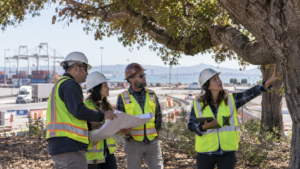
California’s transportation and logistics network depends on far more than highways, trucks, ports, rail lines, warehouses, and distribution centers. Every major infrastructure project takes shape within an existing landscape, and in the Bay Area that landscape frequently includes mature trees, protected vegetation, environmentally sensitive areas, established neighborhoods, utility corridors, and municipal requirements that must be addressed before construction can move forward.
For developers, transportation planners, civil engineers, public agencies, logistics companies, property owners, and construction teams, trees can become a significant part of the planning process much earlier than expected. A mature tree near a proposed roadway expansion, loading area, warehouse entrance, utility trench, parking facility, or transit improvement can influence design decisions long before equipment arrives on the property.
This is one reason consulting arborists are increasingly becoming part of the pre-construction team.
The importance of careful planning becomes especially clear when considering the scale of the region. The Metropolitan Transportation Commission identifies goods movement as an important component of the Bay Area transportation system and has developed regional planning strategies addressing freight facilities, major corridors, economic activity, environmental effects, and surrounding communities.
For California Transportation and Logistics News, the growing intersection between infrastructure and arboriculture represents an important development in the way Bay Area projects are being planned.
Transportation Construction Begins Long Before the First Excavator Arrives
Modern transportation and logistics projects can require months or years of planning before construction begins. Site surveys, engineering studies, environmental reviews, utility coordination, permitting, drainage considerations, traffic planning, design revisions, and community concerns can all influence a project’s final configuration.
Trees are increasingly part of that early evaluation.
A project may appear straightforward on a preliminary site plan, yet mature trees can introduce factors that affect grading, excavation, road alignment, underground utilities, staging areas, drainage improvements, sidewalks, driveways, parking areas, and access for construction equipment.
Tree roots also extend beyond what can be seen above ground. Construction occurring near a tree can affect its root system even when the trunk remains untouched.
For project teams, identifying those conflicts before final plans are completed can provide considerably more flexibility than discovering them after construction has begun.
The broader Bay Area transportation system itself demonstrates why coordination matters. Wikipedia’s overview of transportation in the San Francisco Bay Area describes a complex regional network of highways, rail systems, airports, ferries, bridges, transit operations, and local transportation agencies.
Infrastructure projects operating within such a dense environment rarely exist in isolation.
Consulting Arborists Add Specialized Information to Pre-Construction Planning
A consulting arborist can evaluate existing trees and provide information that architects, engineers, developers, contractors, and project managers may need during planning.
That work can include identifying tree species, evaluating condition and structure, documenting tree locations, examining potential construction impacts, reviewing proposed development plans, identifying root protection concerns, preparing arborist reports, and recommending reasonable tree protection measures.
For Bay Area projects requiring specialized tree expertise, working with a Consulting Arborist Bay Area CA can help project stakeholders understand existing tree conditions before important construction decisions are finalized.
The objective is not simply to preserve every tree regardless of circumstances. Professional arboricultural consulting provides project teams with better information so they can understand which trees may be viable for retention, which may conflict with planned improvements, and what measures may reduce avoidable damage.
That distinction matters on complex sites where transportation needs, property improvements, public safety, infrastructure requirements, and existing vegetation all compete for limited space.
Early Tree Evaluation Can Reduce Expensive Design Conflicts
Late discoveries are expensive in construction.
When tree-related concerns emerge after engineering plans have been substantially completed, a project team may have fewer practical alternatives. Changes can require revised drawings, additional engineering, contractor adjustments, permit modifications, new reviews, or changes to construction sequencing.
Early evaluation creates more room for problem-solving.
A consulting arborist might identify a root protection area that influences the placement of a sidewalk, recommend adjustments to excavation methods, document trees near a proposed access road, or evaluate whether construction activity is likely to affect trees along a property boundary.
Even relatively small design changes can be easier to incorporate during planning than during active construction.
This approach aligns with the broader principles behind transportation planning itself. The Federal Highway Administration’s Freight Planning program emphasizes the integration of freight considerations into statewide and metropolitan transportation planning and recognizes the involvement of public and private stakeholders in that process.
Adding specialized professionals when relevant follows the same basic principle: important site conditions are easier to manage when they are identified before major decisions become difficult to change.
Bay Area Freight Infrastructure Makes Site Planning Especially Important
Northern California is a major gateway for domestic and international commerce.
The Bay Area contains highways, rail facilities, industrial properties, marine terminals, airports, distribution facilities, commercial corridors, and local streets that collectively support regional goods movement.
The Port of Oakland, for example, is implementing roadway and terminal infrastructure improvements through its Port and Freight Infrastructure Program. The program includes roadway rehabilitation and other projects intended to improve access, safety, mobility, and freight operations.
Projects elsewhere in the region may be dramatically different in size, yet many face the same fundamental challenge: improving infrastructure while working within an existing built and natural environment.
A logistics property may need a redesigned truck entrance. A commercial site may require expanded loading access. A municipality may improve a roadway or pedestrian corridor. Utilities may need to be relocated. A transportation facility may require new paving, drainage, lighting, or circulation patterns.
Existing trees can affect each of those improvements.
When arboricultural conditions are documented early, designers can make decisions with a clearer understanding of what already exists on the site.
Tree Roots and Construction Often Compete for the Same Space
One of the most important issues in construction near established trees exists underground.
Roads, sidewalks, curbs, utility lines, stormwater infrastructure, foundations, parking areas, and grading work all require space beneath the surface. Tree roots occupy that same environment.
Excavation can sever structural or absorbing roots. Soil compaction from heavy equipment can reduce pore space in soil. Changes in grade can alter the conditions surrounding a root system. Construction materials stored beneath a canopy may compact soil or physically damage roots.
These impacts may not produce immediate visible symptoms.
A tree can remain standing after construction and decline later because its root system was substantially affected during site work. That delay can make it difficult for property owners and contractors to recognize the relationship between construction activity and later deterioration.
Pre-construction documentation provides a clearer baseline.
An arborist can record conditions before work begins and establish protection recommendations appropriate to the site. Those recommendations can then be incorporated into construction documents or communicated to contractors before activity begins near affected trees.
Transportation Projects Must Balance Mobility With Environmental Conditions
Transportation planning increasingly includes environmental considerations alongside mobility and economic objectives.
Caltrans Strategic Freight Planning describes California’s goods movement network as a combination of public and private infrastructure operating across local, regional, national, and global systems. Caltrans also recognizes environmental, community, safety, and infrastructure considerations within freight planning.
The state’s current long-range freight planning work continues this broader approach. The California Freight Mobility Plan 2027 is being developed to guide California freight planning and capital investments while considering economic competitiveness together with social and environmental needs.
For individual projects, environmental responsibility often begins with understanding existing site conditions rather than reacting to them after construction starts.
Tree evaluation is one part of that process.
Arborist Reports Can Become Valuable Project Documentation
Documentation has an important role in development and infrastructure work.
A professional arborist report can create a written record of tree conditions at a particular point in time. Depending on project requirements, it may document species, size, condition, structural observations, location, construction concerns, recommended protection measures, and other site-specific information.
That information can be useful to several parties.
Engineers may use it while refining plans. Architects and landscape professionals may incorporate recommendations into site design. Contractors may use tree protection specifications during construction. Property owners may use the report when reviewing project alternatives. Municipal agencies may require arboricultural documentation as part of planning or permitting procedures.
The report creates a common reference point among people approaching the project from different professional disciplines.
For large projects involving numerous consultants, that shared documentation can become particularly valuable.
Tree Protection Can Influence Construction Logistics
Transportation and logistics professionals understand the importance of movement through constrained spaces.
Construction sites operate under similar pressures.
Equipment requires access. Materials require storage. Trucks need staging areas. Excavated soil must be managed. Temporary fencing may be installed. Workers need safe circulation routes. Utility crews need access to specific portions of the property.
Tree protection areas can affect where those activities occur.
If those areas are established after the contractor has already planned site logistics, conflicts can quickly develop. If they are identified during pre-construction planning, staging and access can be designed around them where practical.
This turns tree protection from a last-minute restriction into a known construction parameter.
The same planning philosophy can be seen at a regional scale. The California Transportation Commission is responsible for programming and allocating funding for highway, passenger rail, transit, and active transportation improvements throughout California while also participating in the development and evaluation of state transportation policies and plans.
Large transportation systems depend on planning, coordination, and sequencing. Individual construction sites benefit from the same discipline.
Urban Trees Can Also Be Part of Transportation Infrastructure
Trees are sometimes treated as landscaping that exists alongside infrastructure. In developed communities, however, their relationship with transportation systems can be much closer.
Street trees may line roadways and sidewalks. Mature trees can stand beside transit facilities, parking areas, commercial loading zones, trails, intersections, utility corridors, and redevelopment sites.
Their condition can influence pedestrian areas, sight lines, construction access, pavement, and maintenance requirements.
Transportation improvements therefore cannot always separate the built environment from the surrounding landscape.
The Bay Area’s long-range planning process illustrates the degree to which transportation and land use are interconnected. The Metropolitan Transportation Commission’s long-range planning program coordinates transportation planning with broader regional considerations, including housing, development, connectivity, and future investment.
At the project level, understanding trees and other existing site features supports that same integrated approach.
Pre-Construction Arboriculture Can Support Better Communication
Major projects involve people with different priorities.
The developer may be focused on schedule and budget. Engineers may be focused on technical feasibility. Contractors may be focused on constructability. Municipal agencies may be focused on compliance and public infrastructure. Nearby property owners may be concerned about neighborhood impacts.
Trees can become a source of conflict when expectations are unclear.
An independent professional assessment can create a more objective basis for discussion.
Instead of relying on assumptions about whether a tree is healthy, hazardous, worth retaining, or likely to survive construction, project stakeholders can refer to documented observations and recommendations.
Clear information does not eliminate every disagreement, but it can make discussions more productive.
Timing Is One of the Most Important Decisions
The greatest value of consulting arborist involvement may come from timing.
Bringing an arborist into a project after grading has begun limits the available options. Bringing one in while the project is still being designed allows arboricultural information to influence decisions when modifications are easier.
This does not mean every transportation or logistics project requires extensive arboricultural analysis.
It means projects containing mature trees, protected trees, significant landscaping, neighboring trees, street trees, or construction activity near established root systems may benefit from identifying those conditions before work begins.
Early review can help determine whether additional arboricultural involvement is necessary and where it should be concentrated.
California Transportation and Logistics Projects Are Becoming More Interdisciplinary
The future of transportation and logistics infrastructure will require collaboration across disciplines.
Civil engineering, freight planning, environmental analysis, construction management, utilities, land-use planning, landscape architecture, traffic engineering, and arboriculture can all intersect on the same site.
California’s transportation network continues to evolve through public investment and private development, while Bay Area communities remain some of the most complex development environments in the country.
That combination increases the value of specialized planning.
A tree that appears to be a minor feature on an early conceptual drawing can become an engineering, permitting, construction, safety, or property-management issue later. Evaluating it early provides the project team with information while meaningful choices remain available.
Conclusion
California Transportation and Logistics projects operate within a complicated network of infrastructure, communities, businesses, environmental resources, and existing development. In the Bay Area, mature trees are frequently part of that environment.
Consulting arborists are becoming valuable pre-construction resources because they help project teams understand those trees before construction decisions become expensive or difficult to change. Their assessments can support design coordination, construction planning, tree protection, documentation, communication, and long-term property management.
For transportation, logistics, commercial development, and infrastructure teams, the lesson is straightforward: what stands beside a roadway, warehouse, terminal, utility corridor, or construction site can matter just as much as what is being built.
As California continues investing in freight mobility, transportation improvements, resilient infrastructure, and regional development, early coordination between planners, engineers, contractors, environmental professionals, and arborists can help projects move from concept to construction with fewer avoidable surprises.
For California Transportation and Logistics News, the growing role of consulting arborists reflects a broader change taking place throughout infrastructure development. Successful projects increasingly depend on understanding the entire site before construction begins, including the parts of the project rooted firmly in the ground.