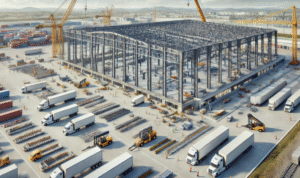
Building a transportation and logistics center is no ordinary real estate or industrial project. It’s a complex orchestration of civil, structural, mechanical, electrical, IT, regulatory, and infrastructure systems—often with heavy demands for connectivity to roads, rails, utilities, and distribution networks. The stakes are high: any misalignment, delay, or budget overrun can ripple through a company’s supply chain and erode competitive advantage.
In such an environment, an owner cannot simply delegate oversight to architects or general contractors and hope for the best. An owner representative—a dedicated professional or team advocating directly for the owner’s interests—can make the difference between a facility that meets expectations and one that becomes a white elephant. In this article, we explore in depth why someone building a transportation and logistics center absolutely needs owner representation, the tangible benefits, and the risks of skipping that role.
The Unique Complexity of a Transportation & Logistics Center
Before jumping into the “why,” it’s essential to appreciate what makes a logistics center project uniquely complex compared to a typical warehouse or light industrial building:
-
Multi-modal integration: Many logistics centers interface with roads, highways, rail spurs, ports, or air cargo facilities. Aligning schedules, clearances, grades, and interface design is a challenge.
-
Heavy utility demands: These centers often require high electrical loads (for lighting, conveyors, mechanical systems), advanced HVAC control, sometimes clean rooms or cold storage, backup generation, fire suppression systems, and more.
-
IT / automation: Modern logistics hubs are increasingly automated (conveyors, sorters, robotics, warehouse management systems). The building must be “smart” from Day 1.
-
Traffic, staging, and circulation: Truck ingress/egress, internal circulation, loading docks, staging yards, parking—all must be designed for high throughput.
-
Phased commissioning: Many such centers open in stages; coordination across phases is critical.
-
Regulatory, permitting & environmental challenges: Grading, drainage, stormwater, wetlands, noise, traffic impact studies, and local transportation access permits are often involved.
Given this complexity, the typical roles of architect, engineer, and contractor are necessary but insufficient to protect the owner’s full interests. That’s where the owner representative adds enormous value.
What Is an Owner Representative (OR)?
An owner representative (sometimes called owner’s rep, owners’ rep, or owner’s construction representative) is an independent professional (or firm) engaged by the owner to act as the owner’s advocate throughout the project lifecycle—from conception through closeout. They are not designers or builders; rather, they oversee, coordinate, and protect owner interests across all interfaces. Mastt+2indsysconsulting.com+2
Key responsibilities typically include:
-
Advising on project strategy, phasing, and budget
-
Helping develop the program requirements and scope
-
Reviewing design deliverables for compliance with owner goals
-
Assisting in contractor procurement, bid evaluation, and contract negotiation
-
Monitoring costs, schedule, risk, and quality
-
Coordinating communication among all stakeholders
-
Overseeing change orders, claims, and dispute management
-
Facilitating commissioning, testing, turnover, and closeout processes
-
Ensuring the project aligns with owner business objectives without surprises
In short, the OR is the owner’s “eyes and ears” on the ground. indsysconsulting.com+2The Concord Group+2
Why Owner Representation Is Vital for a Logistics/Transportation Center
1. Risk Mitigation & Accountability
Any large industrial or infrastructure project carries significant risk: cost overruns, schedule delays, design conflicts, constructability problems, contractor defaults, unforeseen site conditions, regulatory delays, and more. Without a focused advocate, those risks tend to fall on the owner. The OR provides disciplined oversight and early warning systems to detect and escalate issues before they balloon. Buildings+1
In logistics centers, small miscalculations (e.g. inadequate turning radius for tractor-trailers, power load undercapacity, inadequate clearance for automated systems) can cause major operational constraints—or require expensive retrofits. The OR is uniquely positioned to catch such problems during design and ensure contractors do not pass risk back to the owner via change orders.
2. Cost Control and Value Engineering
Because the OR is not a design or trade contractor, they can impartially review cost proposals, challenge inflated change orders, and recommend value engineering without conflict of interest. They help ensure that every dollar spent aligns with owner goals.
In a logistics center, where you may be building large footprint structures, heavy concrete slabs, deep foundations, and sophisticated infrastructure, cost escalation is common. An OR can monitor cost trends, reconcile design vs. budget, vet subcontractor pricing, and hold parties accountable. Mastt+1
3. Seamless Stakeholder Coordination
A transportation and logistics project may involve many stakeholders: civil, structural, mechanical, electrical, IT/automation, traffic consultants, environmental engineers, municipality / DOT authorities, rail or port operators, utility providers, and more. Coordination failures are common unless someone central orchestrates the interfaces.
The OR functions as the coordination hub: they keep everyone aligned to project goals, mediate conflicts, and ensure decisions are made timely. This avoids delays caused by miscommunication or finger-pointing.
4. Ensuring Schedule Discipline
Time is money. Every day of delay on a logistics hub can cost millions in lost throughput, rent, or supply chain disruptions. The OR tracks the critical path, ensures contractors meet milestone obligations, and keeps pressure on lagging parties. If risks to the schedule emerge, the OR helps the owner evaluate mitigation options (accelerated work, parallel paths, resequencing).
Also, because logistics centers often open in phases or partial operations, the OR helps manage phased commissioning and handover to align with business ramp-up.
5. Design Quality & Operational Alignment
One of the biggest challenges in complex facilities is that what gets built must work operationally. The OR helps ensure that design decisions reflect operational needs (flow of materials, automation interface, maintenance access, energy efficiency, future expansion). They review design deliverables to confirm that the owner’s program is honored, and point out design inefficiencies or conflicts before they are built.
In a logistics center, even small misalignments—overlooks of clearance, power drop locations, conduit runs, control system interfaces—can lead to operational bottlenecks or unexpected retrofit costs.
6. Control Over Change Orders & Claims
Change orders are inevitable, especially in a project of high complexity. Without a strong owner-side representative, contractors may exploit ambiguities to drive up extras. The OR ensures that change orders are properly vetted, priced, and approved (or rejected) in a controlled process. They also help manage claims and disputes, preserving the owner’s rights.
7. Commissioning, Testing & Turnover
Construction does not end with walls and roof. Especially in logistics centers, commissioning of systems (mechanical, fire suppression, automation, controls), integration testing, punch lists, commissioning protocols, and staff training are critical. The OR oversees all turnover processes to ensure the project is delivered in a state ready for operations, with minimal disruption.
They help ensure contract closeout, warranties, as-built documentation, and lessons-learned processes are completed.
8. Bridging the Owner’s Internal Capacity Gaps
Most companies building transportation or logistics centers are not construction experts. They may lack the in-house staff with domain experience in heavy infrastructure, automation integration, or industrial construction oversight. The OR provides that domain expertise on day one, allowing the owner’s leadership to focus on strategy, financing, and business growth rather than construction minutiae.
Counterarguments & Risks of Skipping Owner Representation
It’s fair to ask: isn’t this just extra expense? Might the architect or general contractor suffice? Here’s why skimping is often a false economy:
-
Conflict of interest: Architects and contractors have their own financial and schedule interests. They are not incentivized to catch cost overruns that reduce their margin. With an OR, there is an independent voice advocating only for the owner.
-
Less oversight in early stages: Many fatal flaws happen in the early schematic and design phases. If no OR is present, these flaws may persist until construction, when the cost to fix is much higher.
-
Reactive rather than proactive: Without dedicated oversight, problems tend to be discovered late, when options are limited and costly.
-
Operational misalignment: Without someone focused on the operational intent, design decisions may satisfy structural or architectural perspectives but fail to support logistics flows.
-
Lost value: Costly change orders may go unchecked, and opportunities for value engineering may be missed.
In short, the cost of the OR is typically a small fraction of the total project—yet the savings, risk avoidance, and peace of mind they bring often justify many times their fee. Many owner representation contracts are structured at 1 %–5 % of construction cost, depending on project complexity and scope. Mastt+2The Concord Group+2
Real-World Signals from the Transportation & Logistics Industry
To underscore the criticality of having strong alignment, oversight, and adaptability, one can look at current trends in transportation and logistics:
-
Supply chain volatility and disruption: Global supply networks are strained by geopolitical shifts, tariff uncertainty, labor challenges, and congestion. Companies are investing heavily in more resilient and flexible logistics infrastructure. Supply Chain Dive+1
-
Technological acceleration: Automation, robotics, AI route optimization, and smart logistics are becoming table stakes. In one recent deal, IKEA acquired Locus, a logistics tech firm, to streamline route planning and delivery optimization. Reuters
-
Massive infrastructure plays: FTAI Infrastructure’s $1.05 b acquisition of the Wheeling & Lake Erie Railway (a freight rail asset) highlights how logistics infrastructure is commanding high strategic value. Reuters
-
Labor constraints: The logistics sector is facing a shrinking talent pool and pressure for higher wages, increasing the premium on well-planned, efficient projects. MHL News
These trends amplify the risk of misaligned, poorly managed projects. When infrastructure and logistics become strategic differentiators, the quality of your project execution—and the alignment of the built facility with your operational goals—becomes absolutely critical. In that environment, owner representation is not optional; it’s foundational.
How to Choose & Structure an Owner Representation Role
Given the importance, here are key criteria and tips:
-
Domain expertise
Look for ORs with experience in industrial, infrastructure, and logistics-related construction (not just generic commercial). They should understand material handling, automation, traffic flow, utility systems, and multimodal operations. -
Independence & integrity
The OR must be clearly independent of contractors or designers so their advice is unbiased. Compensation structure should discourage conflicts of interest. -
Scope clarity
Define clearly the phases in which the OR will be engaged (planning, design, procurement, construction, commissioning) and their deliverables and authority. -
Fee structure aligned with risk & complexity
Large, complex logistics centers may justify a higher percentage (closer to 3 %–5 %) of the construction cost. For projects with less complexity, lower percentages may suffice. -
Strong communication & reporting
The OR should provide regular dashboards, risk registers, cost vs. budget reports, schedule snapshots, and decision logs. They should act as a transparent liaison between all parties. -
Authority & escalation rights
While the OR usually doesn’t have direct contractual authority over contractors, they must have escalation rights to the owner for decisions and must be included in major decision-making processes and approvals. -
Early engagement
The best time to bring in an OR is during early planning and programming—before significant commitments are made. Their input at that stage prevents wasted effort down the road.
Conclusion
Building a transportation and logistics center is among the most challenging forms of construction: one must navigate infrastructure, automation, regulatory, multi-modal, and operational demands all at once. In this context, relying solely on architects or contractors to protect the owner’s interests is simply insufficient.
Owner representation offers the strategic oversight, discipline, coordination, and accountability that align a complex project with the owner’s business goals. They bring early warning systems, cost controls, value engineering, stakeholder orchestration, commissioning oversight, and a lens of operational reality that keeps the project from drifting off course.
When logistics becomes mission-critical and supply chain resilience is under pressure, the cost of oversight failure is high. In that world, owner representation is not a luxury—it’s an essential investment in delivering a center that functions as intended, on time, and within budget 😊.
Further reading
-
FreightWaves (transportation & logistics news)
-
Transport Topics (trucking & freight news)
-
Wikipedia’s page on Iraq–Europe Development Road (an example of large-scale transportation corridor projects) en.wikipedia.org